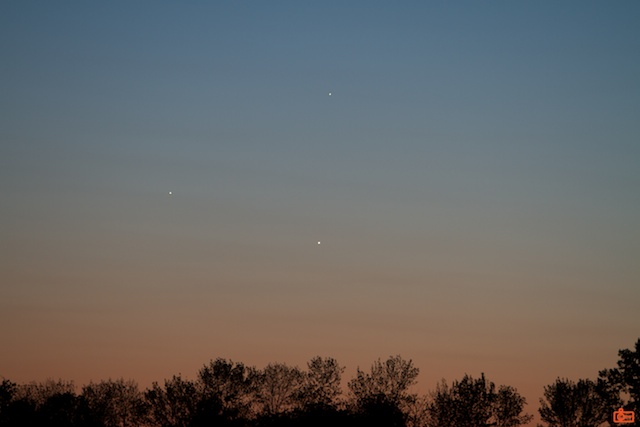
Venus at bottom, Mercury at the top, Jupiter on the left, Earth in the foreground. Four of the 7 visible planets in one shot. We won’t see a closer grouping until 2026.
Just a Canadian curious about the world
Venus at bottom, Mercury at the top, Jupiter on the left, Earth in the foreground. Four of the 7 visible planets in one shot. We won’t see a closer grouping until 2026.
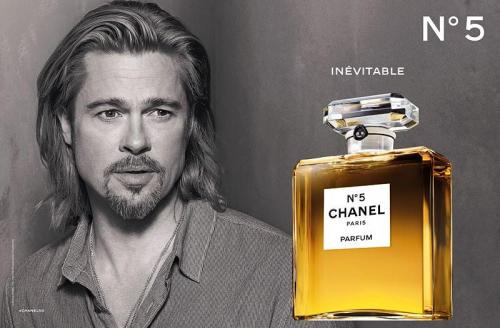
I have to say that the simple B&W photos of Brad Pitt in the new ad campaign Chanel No. 5 perfume are fantastic. In the Ministro Pistarini International Airport (Buenos Aires), there are huge posters of the ads down the length of the concourse.
The photographer is Steven Klein. They are very well shot. This is apparently the first time a man to represent a female fragrance.
Rosa, Mama and I went to watch the 2012 Capital Pride Parade this afternoon. It’s good to see the support the community has in Ottawa.


Over time, my father and I have been more and more distant from each other. Of course, the physical distance plays a role in our emotional distance. Over the last year, I have desired to reconnect with him (and my entire family). In the spring, he suggested that something he has always wanted to do was to go to the Oshkosh Air Show. I thought this would be a good opportunity to spent time with him.
As he lives in Nova Scotia, I arranged for us to meet at Pearson for our flight from Toronto to Milwaukee.
I worked Thursday morning then left for the airport just before noon. Once in Toronto, I went to the gate were I hoped I would meet up with Dad. I waited and waited, while continuing to work using my laptop (I still have a heavy work load). The time passed and there was no sign of him. I tried calling his cell phone, but got no answer. I grew more and more concerned. Eventually, the plane started boarding, but still no sign. Once I was seated, one of the crew stopped at my seat and asked my name. I told him. As he walked away, I thought that there might be some confusion, so I told him that my Dad and I have the same name. I explained that he was missing. They then closed the door, with the seat beside me empty.
The stewardess stopped by to ask about the situation. She allowed me to make a final call to his cell phone, and finally he picked up. He had just arrived – his flight left Halifax 3 hours late. He would have to rebook somehow. The person behind me, who had overheard my situation, suggested that he book on a flight to Chicago and take a special hourly bus between O’Hare and the Milwaukee airports. The stewardess said I could make one more call if I could do it quickly. Thanked her a million times and called Dad to give him the details. Then the plane took off.
Once in Milwaukee, I took my time getting my bags and looking at the General Billy Mitchell museum in the terminal before I attempted to call Dad again (in case he was still on the way to Chicago). He picked up immediately. He was not able to get on the Chicago flight, so I would need to pick him up the next morning when he arrives on the morning flight from Toronto.
Luckily, I brought my iPod for listening to audiobooks, because it is 2 hours from the Billy Mitchell Airport to our hotel in Appleton.

Once I collected my dad the next morning, we drove straight to Oshkosh. As a special treat for us, I had bought tickets for a flight on a B-17G bomber, named “Aluminum Overcast“. We had to check-in for the flight just after noon, so I wanted to get to the pick-up location quickly. I didn’t know how long it would take to walk from the parking to the check-in both (or how difficult it would be to find), so we rushed.
We got there with lots of time (they were about an hour behind schedule), but I am glad I made it a priority to get there early. Oshkosh is huge! It was the 60th Anniversary of the airshow. There would be about 508,000 spectators during the weekend, 10,000 to 15,000 planes of all sizes, and 4,000 volunteers. The planes ranged from an Air Force C-5 Galaxy to ultralights, from vintage biplanes and World War II Warbirds to an F/A-18 Hornet, plus the Goodyear Blimp.
The B-17G flight leaves from nearby Outagamie County Regional Airport, which is in Appleton. From the check-in booth, we boarded a shuttle bus for the 30-minute ride. We arrived just as the previous flight was leaving, so we got to watch the plane take off.
Once it returned, we were given a quick safety overview and allowed to board. We were told we could unbuckle and start to walk around the plane as soon as all the wheels were off the ground.
The climb-out was gentle, which was best when people are climbing around the fuselage. As we took off, I tried to imagine what it would have been like for those World War II airmen taking off to bomb Deutschland – the tension, the fear, knowing that sometimes the planes don’t come back, facing uncertain death before your 25th birthday.
I took in all the sights and noises. It was actually a lot of fun to take the flight. The views were amazing. We could go up to the bombardiers seat up in the nose for a spectacular view. I didn’t dwell on what it would have been like for the bomber, knowing he would be dropping 4-tons of ordinance on people living in a city not dissimilar his own hometown.

The flight was about 20 to 25 minutes long. I had an opportunity to go through the entire plane, from the tail (but not tail gunner’s position), the waist turrets, the radio area, the bomb bay, the cockpit and the bombardiers position in the nose. In the radio section part of the upper fuselage was removed and you would stick your head out the top of the plane and look around. It was one of the most amazing things I’ve ever done. The turbulent air stream blew me around as I had a completely unobstructed view of the ground and the topside of the plane.
I didn’t want it to end, but it did. Too soon we were back on the ground. In the hot afternoon and exhausted from the thrill, I fell asleep in the bus ride back to Oshkosh.
Once back at Oshkosh, we mostly wandered through the Warbirds section.
In the evening, we had dinner at Bennigan’s across the street from our hotel. I ordered a Monte Cristo. I thought a grilled sandwich would hit the spot. What I did not expect was that Bennigan’s deep-fries the Monte Cristo and dusts it with icing sugar. And it has two sandwiches, not just one. I was shocked when the dish arrived. I cannot imagine (nor does Bennigan’s display) how many calories were on the plate. They offered to make another one without deep-frying, but I hate to waste an entire plate of food so I went ahead with this monstrous meal. I could only eat half which made me feel bad for the waste. I also felt physically awful all night long as the massive amount of oil worked through my veins.
The next day we walked around another section of the huge air show. In one plaza were the modern jets, including the C-5 Galaxy, E-2C Hawkeye, F-16 Falcon, P-3 Orion, KC-135, a DC-10-based Eye Clinic, and another B-17.
We walked around the nearby displays. At the GoPro booth, I ordered a new Motorsports Hero 2 and the battery backpack. The Honda HA-420 Hondajet was interesting, clear-paper design. There were many booths and displays for safety gear and lots of tools for navigation.
We caught part of the talk by the Tuskegee Airmen, but missed the talk by one of the Doolittle Raiders. We watched two Ford Trimotor’s taking load after load of passengers for short flights.
After lunch (mmmm, BBQ pulled pork sandwich), we found a spot to view the afternoon air show.
The show lasted about 3 hours. There were stunt planes, an F/A-18 demonstration, Canadian Forces Skyhawks and Liberty Parachute teams and a huge re-enactment of the bombing of Pearl Harbor and the war in the Pacific.

The Pearl Harbor demonstration was both awesome and disconcerting. While I understand that the event was an important historic event, I wondered if anyone else thought it was strange to re-enact what was basically a massive American military defeat with a large loss of life. The demonstration included later American victories like the daring Doolittle Raid, so I guess it’s a wash. But then, so many battles are still re-enacted through the world, such as the American Civil War – it’s not a new phenomenon.
On the other hand, the re-enactment was awesome. All air shows become more fantastic with large amounts of dynamite and gallons of gasoline. The explosions were huge!
During the air show, I tried to get some good quality photos. My goal was to create photos good enough for airliners.net. I had rented the Canon 100-400mm f/3.5-5.6 from Lens Rentals Canada. Being able to focus on a fast-moving plane was much harder than I expected. I was using my used Canon 50D while my 7D was being repaired.
The air show ended late in the afternoon. For dinner, my dad recommended we try the Golden Corral Buffet. They have a lot of choice so I could pick and choose, and the food was good. I could get some veggies as well as a selection of BBQ meats, pastas, Asian dishes and desert.
We talked about the family and about the future. For me, the key for this trip was to reconnect with my father. We rarely talk with each other. I wanted to open the door to normalize our relationship.

For the final day of the air show, I wanted to go back and take more photos of the Warbirds that I had missed on Friday. However, when we got to Oshkosh many of the planes had already left. Sunday was the fly-out day for most of the planes. More than half had already disappeared overnight.
We stayed until the afternoon to watch the fly-out, including formations of Warbirds, and the grand finale of the C-5 take off. What a huge aircraft. It never looks like it is moving fast enough to take off. I suppose with an empty cargo hold that it must handle better than when it is fully loaded.
In the evening, the rains started. We had avoided all but a little drizzle, and I was very happy with the weather we had during the previous 3 days.
Early Monday morning we left Appleton for the airport. I planned lots of extra time to get through the rental-car return and airport security. I’m glad I added some buffer, as the TSA randomly choose to go through my luggage.

On our flight back to Toronto, I had little more to say. As the minutes ticked by, we sat in silence, side by side. I realized a fundamental truth. Although I want to get closer to my dad, in many unchangeable ways, we are just different. We have different points of view, different personalities, different priorities, and different social worlds. I was hoping to close the chasm between us. But we don’t have to be the same person – we are individuals. Instead, with this understanding, I can still talk with my father but I won’t set my expectations that we will ever become part of each other’s world.
While we were on our recent Danube cruise vacation, my beloved Canon 7D died. It was late in the afternoon in Regensburg.

As I have only one DSLR body, I frequently change lenses. I switch between my walk-around EF-S 17-55mm f/2.8 to my ultra-wide EF-S 10-22mm. The camera had been acting strangely during the day. I could clear it up by turning the camera off and back on.
When it finally died, I had just completed another lens change and tried to turn it back on. It would not power on at all.
I removed the battery and CompactFlash (CF) card and reinserted them and tried to turn the camera on again, but it still didn’t work.
It was late in the day, and our boat would leave soon. So I decided to head back to the ship to try to troubleshoot.
On the boat, I looked up possible remedies. I changed the battery and the CF card. I found the time & date battery and removed that too. I changed lenses. Nothing worked.
Two days later in Prague, I tried one last effort, buying a new time & date battery. The new battery didn’t work either. My camera was truly dead. I was heartbroken.

Luckily, Rosa and I had purchased a backup camera, a Sony NEX-5N. As it was smaller, lighter and simpler, it was normally carried by Lemin. In this case, I borrowed it to continue for the next 3 days of photos on our trip.
But I felt empty inside. I didn’t feel like a photographer any more. I looked with intense envy at other tourists walking around with DSLRs hanging from their neck.
The Sony is a good camera, and I got most of the shots I wanted, and I really liked using the sweep panorama feature. But it just wasn’t the same for me.
When we got back home, I looked up my warrantee information. I had bought the camera 2 years ago from Henrys and I had bought the extended 3-year warrantee. I was relieved that it would not cost anything for the repairs. The downside is that it will take 4-to-8 weeks for the camera to be returned.
So in the mean time, I needed something I could use. I have tickets to the AirVenture Oshkosh in a few weeks.
I decided to buy a body on eBay and then sell it when my 7D comes back from repair. It would be much cheaper than renting a DSLR body for 2 months from my regular rental location.
After a lot of back and forth between a Canon 5D and an APS-C body, I settled on a Canon 50D. I won’t be tempted to keep it and it’s not too expensive. A Canon 60D or a replacement 7D would be much more expensive, a Canon 5D would lack many features, and a Canon 5D II would be too expensive. I was tempted by the full-frame sensor in the 5D series, but now is not the best time to experiment. I would also loose the ability to use my EF-S 17-55mm; although I do have the wonderful fixed EF 50mm f/1.4.
I will take the 50D with me, along with a EF 100-400mm rented from Lens Rentals Canada, to the Oshkosh Air-show.
Joe McNally is a photographer and instructor that I greatly admire. I read his blog weekly and watch his videos on YouTube. Before I left on vacation, I was told by a friend that Joe would be coming to Ottawa with his “One Light, Two Light” tour. However, I would still be on vacation, but I could make the class offered in Montreal which was the day after I returned. At the last moment before we left for Europe, I bought a ticket, reserved a hotel and booked off one more day of vacation.
I drove in last night, after only a single night at home. I stayed at Hôtel Le Dauphin, which was next to the Convention Centre. The hotel was very nice; it was the only hotel I’ve been in that provided a computer in the room to use. The next morning I walked to the Centre and found my way up stairs to the classroom.
The class had about 100 attendees, a mix of pros and amateurs.
Joe came on stage at 9:00, and did not have a specific agenda or even any prepared activities. It was just him, walking on to the stage and creating some great photos from scratch. He choose folks from the audience to be the models. He was able to create some fantastic portraits of very diverse people. He has a knack for it of course. It was awesome to see him pick someone and pull out such character from them. He has a real talent for this. It is one of the keys to his success in photography is the way he can interact with the subjects.
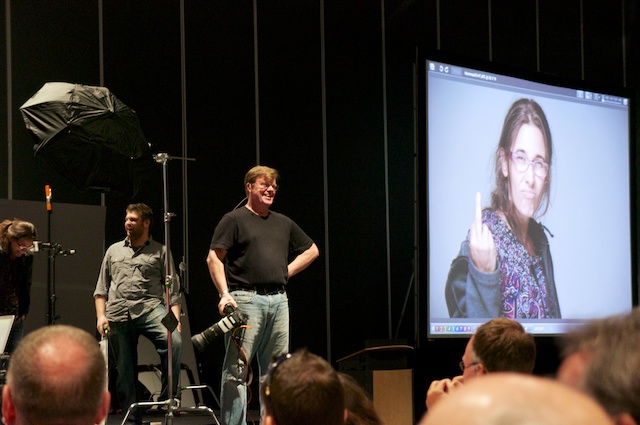
By the end of the event, I was so inspired. I want to try everything I saw. The hardest part to improving in any activity is finding the time!
Today was my last day in Kansas City.
Today was also the extremely rare Venus transit of the Sun. I had been planning to find someplace in Kansas City to buy welders glass #14 so that I could take pictures, but it was hard to find a retail store. Instead, I found out that the local Johnson County Community College was hosting a viewing party.

I invited everyone at the lab to come, but no one took me up on the offer. I left a little early hoping to beat the line-up. When I arrived and found my way into the building, I found that the line-up extended over 2 floors and was over an hour waiting time.
I spoke with one of the JCCC hosts, and they had only expected maybe 150 people. Instead, we calculated they might have about 2000 during the 5-hour transit.
I wish I had had something eat and read while I was waiting. I spoke a little with the others in the line.
When I finally reached the roof, there were two ways to view Venus. There was a hand-made viewing barrel with a solar filter that you hold up to your face. It was fascinating. I used it and hand-held my camera to get the shot below. The odd colour is from the reflections inside the barrel. You can even see some of the sunspots.
There were also three big telescopes set up with special solar filters. Two were sensitive to a particular hydrogen spectrum and one was sensitive to another spectrum. You could see different features using each telescope. It was so amazing to see such details on the disc of the Sun.

I had the pleasure of working with Maygan Wellman, a young model in Gatineau. The evening model shoot was arranged by Denis Duchesne. I attended his natural light model workshop in Gatineau Park last year.
Maygan has a great smile and a ready selection of different outfits. We started outside in the lovely evening sun before moving indoors to the studio. There was one other photographer, plus Denis and Maygan. So we all had ample time to work with Maygan and playing with the studio lighting setups. For me, it was a pleasure to work with an experienced model in a small group. In the larger groups at the RA Photo Club studio events, I used to get very anxious.


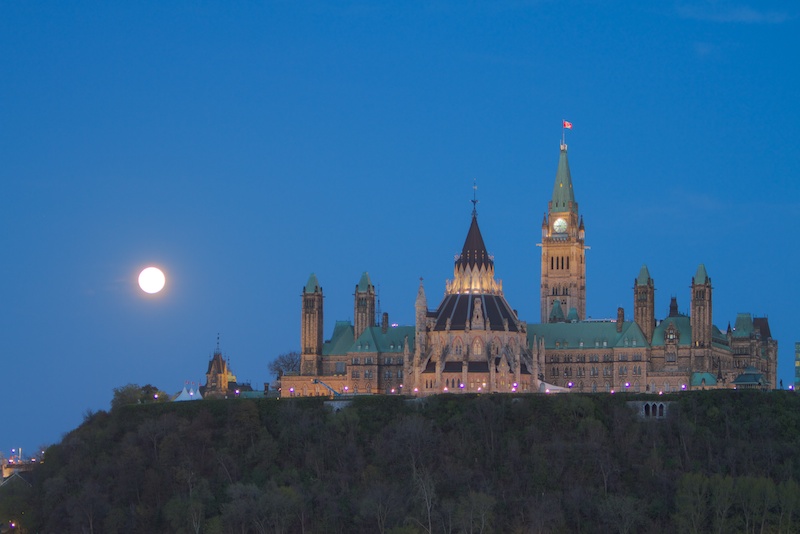
Tonight was the ‘super’ moon, a full moon that occurs 25 minutes before perigee. It would be within 600km of the smallest possible lunar perigee (356,955km vs ~356,400km).

I had some free time in the evening, so I decided to try to photograph the event. I choose to use Parliament Hill as the foreground, so I drove to the Museum of Civilization. There were over a dozen other photographers there, all with tripods like myself. I wasn’t quite sure what lens I should use, but after experimenting, I found that the Canon EF 70-200mm f/2.8 allowed the best magnification of the moon and to bring the moon and the foreground together. If I went with a wider lens (like the Canon EF-S 17-55mm f/2.8), the details would be too small, and the moon would seem insignificant. If I had used the Canon EF 1.4x EXII extender, it would crop the buildings in the foreground.
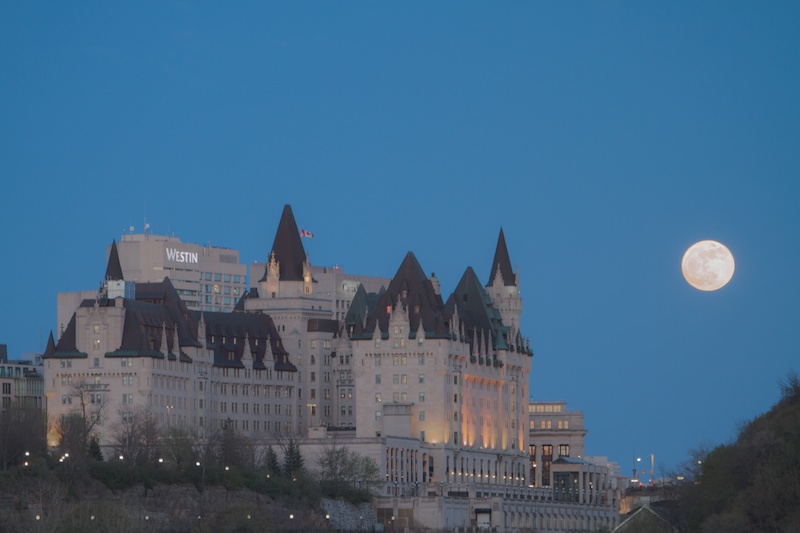
In the end, I was not able to solve the biggest problem – the massive contrast difference between the full (‘super’) moon and the local buildings after sunset. I could not maintain any surface detail on the moon, even if I tried tone-mapping/HDR.